|
NEW AFGHAN TRADEMARK PROGRAM DEVELOPED TO HELP WOMEN WEAVERS
The Afghan Mark Label assures better working, education, health and social conditions for Afghan women weavers.
NEW YORK -- AfghanMark, a new trademark program for branded rugs made by Afghan women weavers has been introduced by The Afghan Women's Business Federation (AWBF).
The program was unveiled at a recent press conference at the Rubin Museum of Art in New York City. The US rug importing community was introduced to the program at a gala event at the Rubin Museum.
The Afghan Women's Business Federation was established in Afghanistan after the elimination of Taliban rule with U.S. assistance from the Center for International Private Enterprise (CIPE) and funding from the United States Agency for International Development (USAID). Funding comes through the US Chamber of Commerce-Department of State.
Funding for the three-year AWBF project amounts to $6 million over three years, according Mark T. McCord, who heads the CIPE project and is headquartered in Kabul, Afghanistan.
"It is certainly a modest investment to establish this framework for women's business, but it will have a massive impact the conditions of working women in Afghanistan." Approximately 80% of the budget is allocated to the AfghanMark program, McCord told Rugnews.com
According to the US Department of Commerce, carpet exports from Afghanistan amounted to $2.5 million in 2002. Over the next three years, it is hoped that total Afghan carpet exports will grow to approximately $18 to $26 million. Afghanistan's principle export markets are the US and Europe, said McCord.
The AfghanMark has been developed to improve conditions of Afghan working women and their families through economic development, rather than charity, according to Halima Kazem, of Kabul, Afghanistan, who is the spokesperson for AWBF.
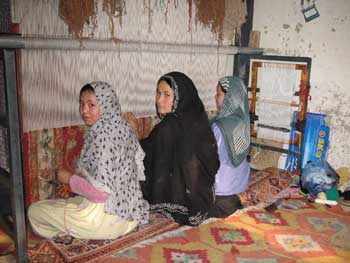
Women weavers at the vertical looms
approved by the AWBF.
The Afghan Mark is a certification label which will be carried on rugs made by Afghan women who are employed by women-owned managed carpet making business in Afghanistan.
The label certifies that the women who made the carpet were paid fair wages while working in inspected working conditions with no illegal child labor, and with access to health care and education, including literacy training.
Each carpet carrying the AfghanMark label will be numbered and will have with it a brief story of the woman or women who wove the carpet.
To date, eight women-owned or women-managed carpet companies or consortiums employing 24,000 weavers have signed on to the AfgahnMark
brand certification program. "We expect the numbers to continue to grow as more companies,
carpet studios and artisans join,€VbCrLf said Kazem.
"This is a major breakthrough for humanitarian, educational and business development by Afghan women for Afghan women in the post-Taliban era,€VbCrLf said Kazem.
"For centuries, many Afghan women have toiled for much of their lives on looms, sometimes barely eking out a living, while making the hand-knotted, world-famous Afghan carpets that are emblematic of the artisan culture of Afghanistan," Kazem said.
Working conditions are still not good for women weavers, and the labeling program has been established to help improve those conditions, Kazem explained.
"Today, many of these hard working women are illiterate, with limited social, health care or educational opportunities. Some are war widows. Most are mothers and many are breadwinners for their families. They sometimes work on the carpet looms for wages as low as $1 per day, or less, while making high-end carpets that sell for premium prices.€VbCrLf
The new AfghanMark trademark brand means empowerment for working Afghan women not through charity, but through business, with fair pay and labor
rights, Kazem stressed. "For these women, the AfghanMark brand means more and better food for their families, education, health care and, above all, greater respect for Afghan women who, under Taliban rule, and in other eras, were often treated poorly," she said.
The AWBF, which created and owns the AfghanMark certification brand, monitors the working conditions of carpet weavers at each loom and assesses the age, health condition, education level and wages of each weaver.
Each participating AfghanMark company, studio or
consortium is required to provide the name, location, age and wage earned by each weaver. This provides a benchmarking measurement matrix by which the independent Afghan International Chamber of Commerce monitors the economic, social and educational well being of all of the weavers.
In addition, each AfghanMark program participant is required to provide proof that his/her weavers have access to health care and education through a
nationally or internationally recognized provider. Proof includes documentation and is validated by unannounced site visits to ensure that standards are met.
AWBF requires carpet companies to invest in the education of all their weavers, both male and female. AWBF requires all carpet companies to use vertical looms so that weavers are not hunched over horizontal floor looms.
Participating AfghanMark companies/organizations are required by AWBF to provide fair compensation to their weavers. The AWBF has set the fair compensation rate at 150% of the current wage rate, and it must be paid directly to the weavers in cash. In addition, companies are required to provide an additional 10% commission on the sale of each carpet payable in cash directly to the woman who wove it.
2.24.07
|